
The Nine Mental Skills of Successful Athletes
Jack J. Lesyk, Ph.D.
You don’t have to be a professional athlete or an Olympic champion to be a successful athlete. Nor do you have to have a room full of trophies, win a state championship, or make the front page of the sports section. Successful athletes that I’ve worked with include an eleven year-old figure skater who has not yet won a competition, a high school golfer with a zero handicap, a middle-aged runner whose goal is to complete her first marathon, a weight lifter who holds several world records, and an Olympic medalist.
What these athletes have in common is that their sport is important to them and they’re committed to being the best that they can be within the scope of their limitations – other life commitments, finances, time, and their natural ability. They set high, realistic goals for themselves and train and play hard. They are successful because they are pursuing their goals and enjoying their sport. Their sport participation enriches their lives and they believe that what they get back is worth what they put into their sport.
There are nine, specific mental skills that contribute to success in sports. They are all learned and can be improved with instruction and practice. At the Ohio Center for Sport Psychology we work with serious athletes of all ages and ability levels to help them learn and sharpen these important skills.
We believe that our work is worthwhile because the same mental skills that athletes use in achieving success in sports can be used to achieve success in other areas of their lives.
A Brief List of the Nine Mental Skills
Successful Athletes:
- Choose and maintain a positive attitude.
- Maintain a high level of self-motivation.
- Set high, realistic goals.
- Deal effectively with people.
- Use positive self-talk.
- Use positive mental imagery.
- Manage anxiety effectively.
- Manage their emotions effectively.
- Maintain concentration.
Mental Skills Training
These nine mental skills are necessary for performing well in sport as well as in non-sport performance situations. At the Ohio Center for Sport Psychology:
- We believe that these skills are learned and can be improved through instruction and practice.
- We begin our work with each individual by assessing his current proficiency in each of the skills.
- We develop a plan for teaching and enhancing the specific skills that need improvement for the individual.
- We periodically reassess the client’s proficiency in each of the skills in order to evaluate our progress.
The Performance Pyramid
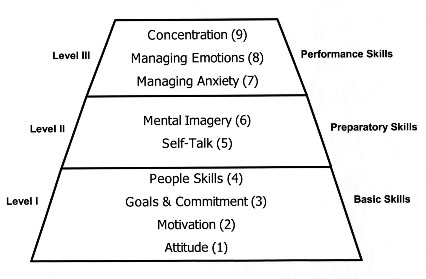
Although each of the nine skills is important, its primary importance will occur during one of three phases: long-term development, immediate preparation for performance, and during performance itself.
Level I - These mental skills constitute a broad base for attaining long-term goals, learning, and sustaining daily practice. They are needed on a day-by-day basis for long periods of time, often months and years.
Level II - These skills are used immediately before performance to prepare for performance. They maybe used just before competition begins, or immediately before a specific performance action, such as a golf shot or a free throw in basketball.
Level III - These skills are used during actual performance behavior.
The pyramid below represents the relationship of the nine skills to one another. Each of the higher levels incorporates and is based upon the skills of the preceding levels.
Detailed Descriptions of the Nine Mental Skills
1. Attitude
Successful athletes:
- Realize that attitude is a choice.
- Choose an attitude that is predominately positive.
- View their sport as an opportunity to compete against themselves and learn from their successes and failures.
- Pursue excellence, not perfection, and realize that they, as well as their coaches, teammates, officials, and others are not perfect.
- Maintain balance and perspective between their sport and the rest of their lives.
- Respect their sport, other participants, coaches, officials, and themselves.
2. Motivation
Successful athletes:
- Are aware of the rewards and benefits that they expect to experience through their sports participation.
- Are able to persist through difficult tasks and difficult times, even when these rewards and benefits are not immediately forthcoming.
- Realize that many of the benefits come from their participation, not the outcome.
3. Goals and Commitment
Successful athletes:
- Set long-term and short-term goals that are realistic, measurable, and time-oriented.
- Are aware of their current performance levels and are able to develop specific, detailed plans for attaining their goals.
- Are highly committed to their goals and to carrying out the daily demands of their training programs.
4. People Skills
Successful athletes:
- Realize that they are part of a larger system that includes their families, friends, teammates, coaches, and others.
- When appropriate, communicate their thoughts, feelings, and needs to these people and listen to them as well.
- Have learned effective skills for dealing with conflict, difficult opponents, and other people when they are negative or oppositional.
5. Self-Talk
Successful athletes:
- Maintain their self-confidence during difficult times with realistic, positive self-talk.
- Talk to themselves the way they would talk to their own best friend
- Use self-talk to regulate thoughts, feelings and behaviors during competition.
6. Mental Imagery
Successful athletes:
- Prepare themselves for competition by imagining themselves performing well in competition.
- Create and use mental images that are detailed, specific, and realistic.
- Use imagery during competition to prepare for action and recover from errors and poor performances.
7. Dealing Effectively with Anxiety
Successful athletes:
- Accept anxiety as part of sport.
- Realize that some degree of anxiety can help them perform well.
- Know how to reduce anxiety when it becomes too strong, without losing their intensity.
8. Dealing Effectively with Emotions
Successful athletes:
- Accept strong emotions such as excitement, anger, and disappointment as part of the sport experience.
- Are able to use these emotions to improve, rather than interfere with high level performance
9. Concentration
Successful athletes:
- Know what they must pay attention to during each game or sport situation.
- Have learned how to maintain focus and resist distractions, whether they come from the environment or from within themselves.
- Are able to regain their focus when concentration is lost during competition.
- Have learned how to play in the “here-and-now”, without regard to either past or anticipated future events.
Application of the Nine Mental Skills to Non-sport Performance Situations
The nine mental skills associated with athletic success are the same mental skills associated with performance in a wide variety of non-sport, performance situations. Let’s take a look at some of these.
Characteristics of A Performance Situation:
- The situation is often scheduled or anticipated in advance.
- The situation usually has a defined beginning and an end.
- The circumstances are known in advance.
- The rules and constraints are known in advance.
- The results are evaluated by standards (or natural consequences) that are usually known in advance.
- The results are uncertain and may involve psychological risk and/or danger.
- The results are important to the performer.
- The performer’s behavior is goal-oriented.
- The results are influenced by the performer’s skillful behavior
Examples of Performance Situations
- An important job interview
- Performing a solo with a symphony orchestra
- Auditioning for a role in a drama production
- Giving a class presentation
- Taking a driver’s examination
- Giving a talk to the PTA
- Testifying in court
- Taking the state medical exam
- Performing brain surgery
- Landing an airplane
- A firefighter entering a burning building
- Participating in a military or police attack
- An astronaut landing a vehicle on the surface of the moon
- Rock Climbing
At the Ohio Center for Sport Psychology we help people develop the important skills necessary for high-level performance in sport and non-sport performance situations.
Copyright © 1998 Ohio Center for Sport Psychology